I built a prototype artificial consumer panel to explore that distinction.
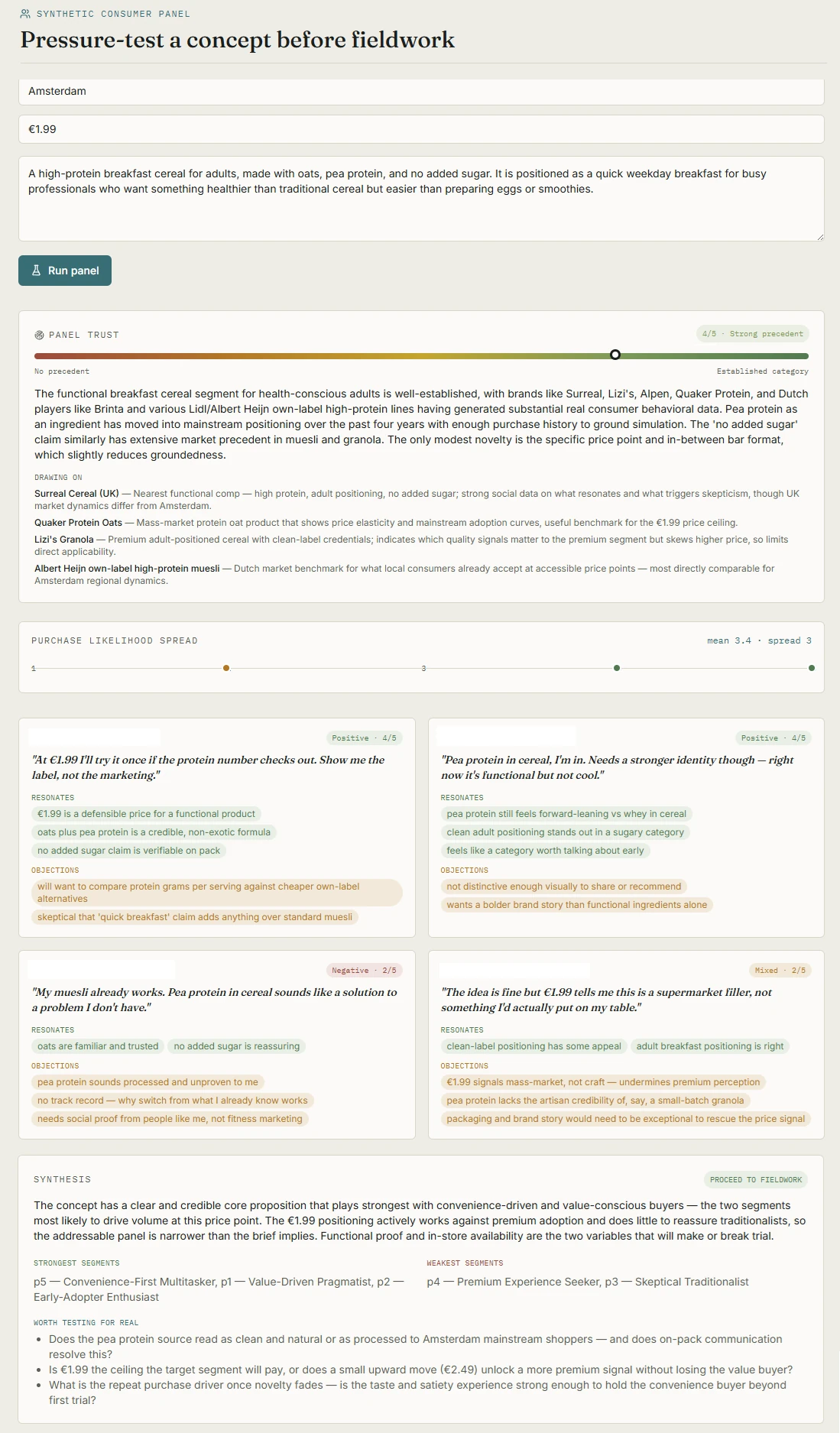
The interface accepts a product description and price point, then asks synthetic panellists with different consumer profiles to evaluate the proposition. They score their purchase likelihood and explain what appeals to them, what creates hesitation and which questions remain unanswered.
The speed is impressive. But speed is the easy part.
Creating responses is not the same as creating evidence
The first version took less than a day to build.
It could present a product idea, positioning, price and claims to multiple artificial consumer profiles. Within seconds, the panellists produced feedback, objections, likely questions and different segment perspectives.
At first glance, this feels like a glimpse into the future of market research. If simulated consumers can provide immediate feedback, does that remove the need for surveys, interviews, panels and observed purchasing behaviour?
Not remotely.
Building an artificial panel is relatively straightforward. Making it more useful than asking a well-prompted language model to “act like a consumer” is much harder.
Without grounding, validation and behavioural evidence, artificial panellists can become a form of synthetic theatre. Their answers sound plausible. They are clearly expressed and often commercially intuitive.
That does not make them representative, predictive or reliable.
The importance of knowing what the panel knows
The feature I find most valuable in the prototype is its “panel trust” assessment.
This looks at how much relevant market precedent exists for the proposition. A familiar product in a well-established category may have a substantial body of existing knowledge behind it. A genuinely novel concept, unusual audience or unfamiliar purchasing context provides a much weaker foundation.
The assessment is intended to make that limitation visible. It helps distinguish between a simulation that has meaningful reference points and one that may be drifting into informed-sounding guesswork.
A confidence score cannot turn synthetic feedback into evidence. It can, however, discourage false certainty and help users interpret the output more responsibly.
Where artificial panels could add value
The immediate opportunity is not to replace conventional research. It is to improve the work that happens before conventional research begins.
Used carefully, an artificial panel could help teams:
- Pressure-test an early product proposition
- Identify unclear claims or missing information
- Expose likely consumer objections
- Compare alternative messages or price points
- Explore how different consumer profiles might respond
- Sharpen research hypotheses
- Improve the questions subsequently put to real people
This could make early exploration faster and reduce the risk of entering fieldwork with an obviously weak proposition or poorly designed questionnaire.
The output should still be treated as a source of hypotheses—not as proof that consumers will think, feel or behave in a particular way.
Real people and real behaviour still matter
Traditional market research is not dead.
Real people matter. Real behaviour matters. Real data and validation matter.
Language models can simulate responses based on patterns in their training and the context they are given. They cannot independently establish whether a new proposition will succeed in the market. Nor can they fully reproduce the inconsistencies, emotions, compromises and contextual influences that shape actual consumer behaviour.
That distinction becomes particularly important when decisions involve significant investment, unfamiliar categories or genuinely innovative products.
AI before market research—not instead of it
The most credible future may not be AI replacing market research. It may be AI operating before it.
Artificial panels could provide a rapid, inexpensive layer of structured challenge at the beginning of the process. Human research could then test the strongest hypotheses, investigate the most important uncertainties and validate what people actually do.
That combination would use AI for what it currently does well: generating perspectives, revealing questions and accelerating exploration.
It would preserve real research for what only real evidence can establish.
The value of an artificial consumer panel should therefore not be judged by how convincingly it imitates consumers. It should be judged by whether it helps us ask better questions when we meet the real ones.