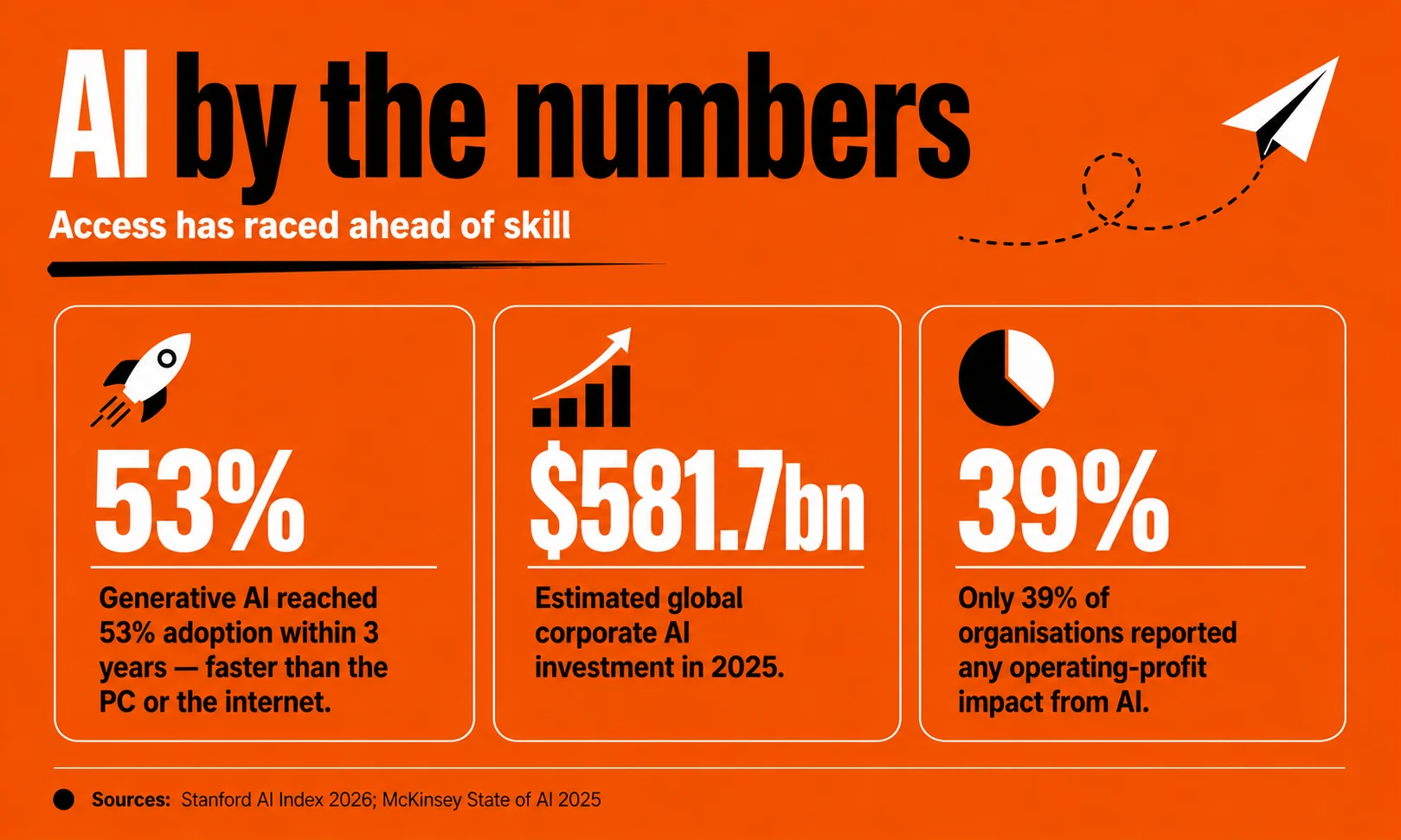
Depending on whom you listen to, artificial intelligence is about to cure disease, eliminate paperwork, transform education and unlock a new era of human prosperity. Or it is coming for your job, your privacy, democracy and possibly the toaster.
The disagreement runs deeper than the headlines suggest. Serious people are looking at the same technology and reaching very different conclusions. That is precisely why waiting feels sensible—and isn’t. Opting out of the argument does not opt you out of the outcome.
Are we living through the Fourth Industrial Revolution?
Possibly. The term describes the convergence of artificial intelligence, robotics, connected devices and biotechnology. AI is one of its most powerful engines rather than the whole revolution neatly packaged in a chatbot.
The label matters less than the evidence: AI is already changing how people search, write software, create media, analyse data, serve customers and make decisions.
AI did not begin with ChatGPT
Artificial intelligence has developed through decades of progress, expectation and disappointment. What changed was the arrival of transformer architectures, greater computing power, enormous datasets, cloud infrastructure and unprecedented investment.
Most importantly, AI acquired an interface the public could use. That usability moved it from research departments into everyday experience.
My own view
I am neither in the “AI will solve everything” camp nor the “we are all doomed by Thursday” camp. The first phase of generative AI was driven by curiosity, fear of missing out and exceptionally large cheques. The next will be dominated by less glamorous questions: Does it work reliably? Does it save or make money? Is it safe? Can it be woven into how the organisation actually operates?
In other words, the fireworks gradually give way to the plumbing. Buying licences is easy; redesigning processes, responsibilities, systems and decisions is considerably harder.
The question that concerns me most
I am optimistic about what AI may become. I am less optimistic about how evenly its benefits will be shared. Technology does not arrive with a built-in fairness setting. The divide may increasingly be between those who have access, understand what is happening and feel able to act, and those who do not.
There is still time
You do not need to become a machine-learning engineer by Friday. You do need to begin forming an informed view of what AI means for your work, your industry and the society you want to live in.
Practical AI fluency means learning how to:
- Verify AI-generated information
- Compare models and choose the right one for the task
- Analyse documents, images and datasets
- Use AI within real workflows
- Understand models, agents, APIs, training data and retrieval
- Recognise privacy, copyright, bias and security risks
- Decide which tasks require human judgement
- Measure whether an AI use case creates value
One decision to make
Decide whether AI is something you intend to understand, or something you will simply use whenever it happens to be convenient.
You are already part of how AI will be shaped. The real question is whether you play that part deliberately, or by default.